How much you need
Less than you fear in the big cities, more than you expect everywhere else. Signs, menus at chains and metro announcements are bilingual. Taxi drivers, small restaurants and shops are not. The gap is closed by two things: a translation app, and having the Chinese written down.
Translation tools
- Apple Translate with the Chinese pack downloaded works offline, including the camera mode for menus.
- Alipay has a translator built in, including conversation mode, and it works on a Chinese network.
- Google Translate only works with roaming data or a VPN.
- Pleco is the dictionary serious learners use; the free version is enough for looking up a menu.
Point the camera at a menu, or hold the phone between you and the other person and take turns. People are patient with it; they use the same tools with you.
Ten phrases
| Chinese | Pinyin | Meaning |
|---|---|---|
| 你好 | nǐ hǎo | Hello |
| 谢谢 | xièxie | Thank you |
| 不要 | bú yào | I don’t want it (to hawkers) |
| 这个 | zhège | This one (pointing) |
| 多少钱 | duōshao qián | How much? |
| 买单 | mǎidān | The bill, please |
| 不辣 | bú là | Not spicy |
| 微辣 | wēi là | Mildly spicy |
| 厕所在哪 | cèsuǒ zài nǎ | Where is the toilet? |
| 扫我 | sǎo wǒ | Scan me (paying) |
AI-generated Mandarin pronunciation.
Etiquette that matters
- Queues are respected at stations and banks, less so at bus stops.
- Tipping is not expected anywhere. Leave the change.
- Cards and gifts are given and received with two hands.
- Chopsticks should not be stuck upright in rice. Rest them on the holder or the bowl edge.
- Loudness in restaurants is normal, not rude.
- Photographs of people are fine if you ask; of military or police sites, not.
Numbers with the hands
These gestures cover numbers one to ten. Most use one hand; the version of ten shown here uses both index fingers. Notice the direction as well as which fingers are extended, especially for eight.
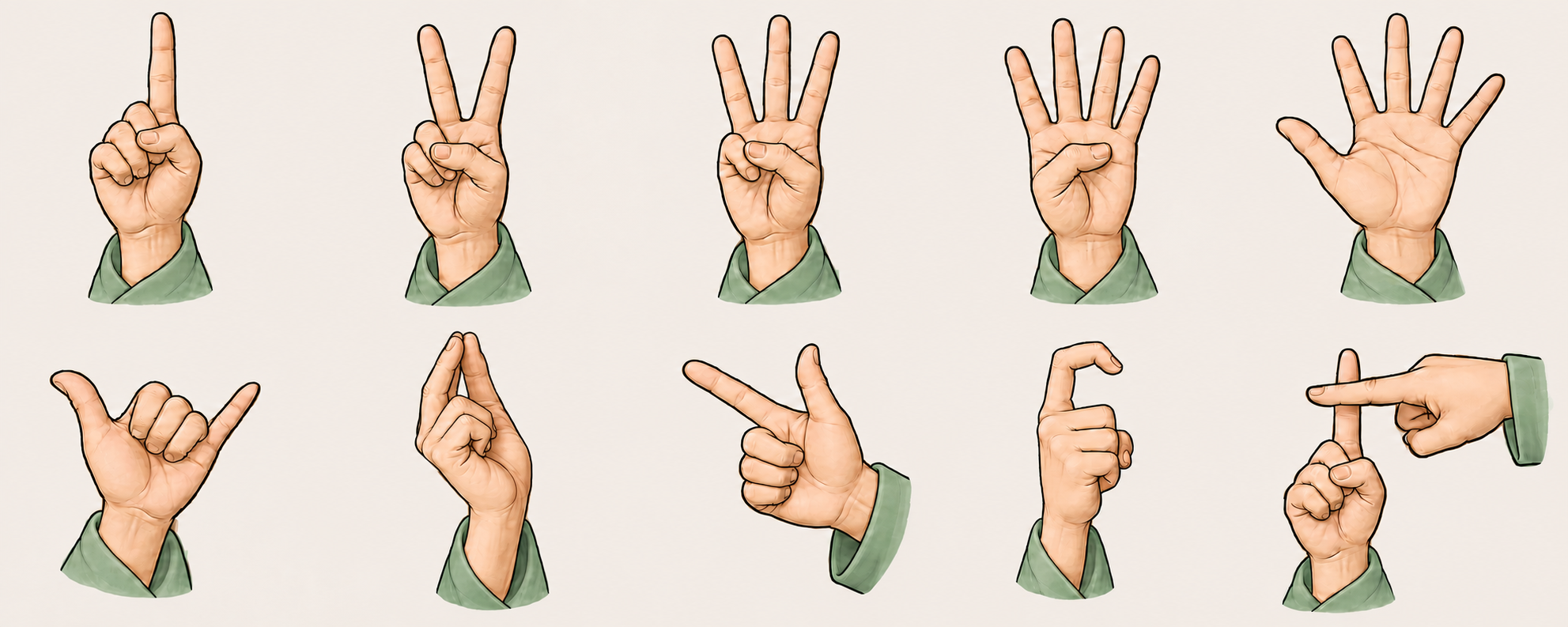
Index finger up; all other fingers folded.
Index and middle fingers up in a V.
Index, middle and ring fingers up; thumb holds the little finger down.
Four fingers up; thumb folded across the palm.
Open palm, with all five fingers spread.
Thumb and little finger out; the other three fingers folded.
Thumb, index and middle fingertips meet in an upward pinch.
Index points out to the side at a gentle upward angle; thumb extended.
Raise the index finger and bend it into a hook; keep the others folded.
Cross the index fingers of both hands: one upright, the other horizontal, like 十.
Was this still accurate when you used it?
Tell me when this changes
Rules and apps change. Get one email when this guide is re-checked or updated, nothing else.
Change history
- 2026-09 — First published.